How to Calculate Your FF&E and OS&E Budget with Figurz
If Figurz looks simple, it's because building it wasn't.
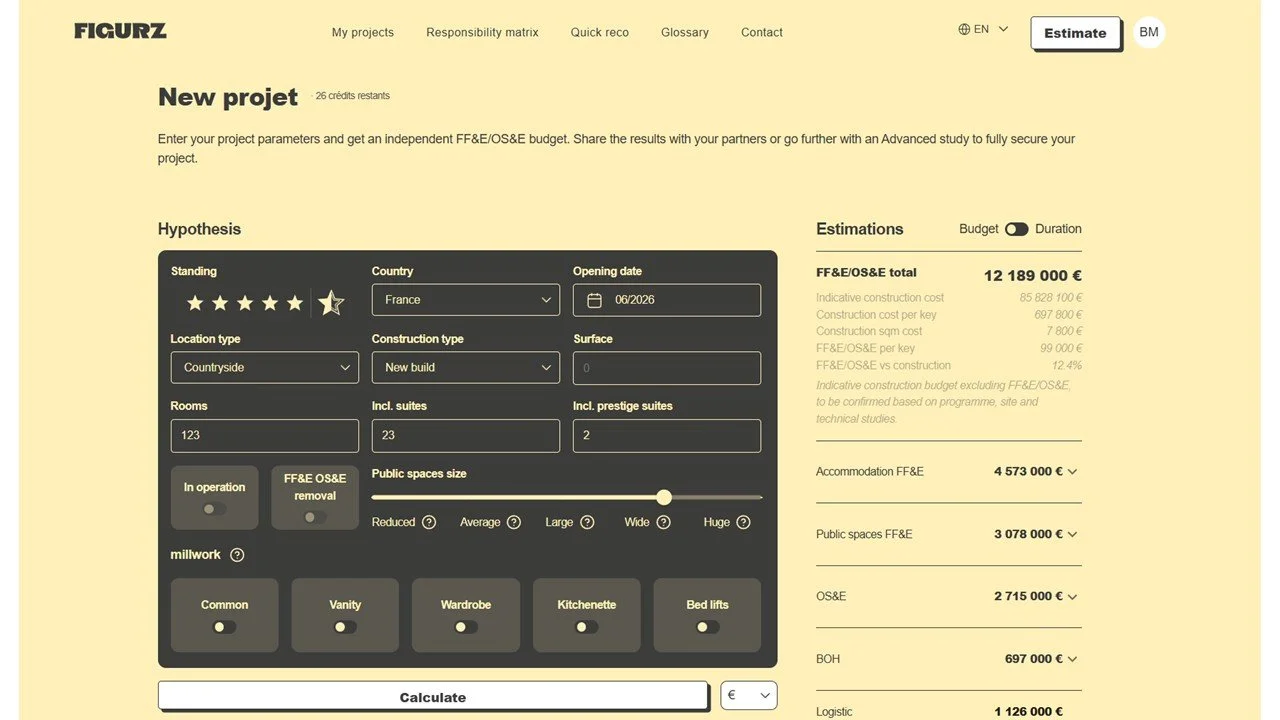
Behind a four-input form is twelve years of FF&E and OS&E projects — 78 million euros, 3,100 keys, fifteen countries — compressed into an algorithm that produces a budget estimate in under a minute. This article explains what Figurz asks for, why it asks for it, and what happens to the number when you change each variable.
Why most FF&E budgets start with the wrong number
The standard approach to early-stage FF&E budgeting goes like this: someone applies a rule of thumb, borrows a number from a previous project, or accepts the figure produced by someone who has an interest in the project proceeding.
None of these produce a number you can defend. A rule of thumb doesn't account for your room mix, your location, or your opening timeline. A borrowed number comes from a different project in a different context. And a motivated number — produced by a procurement agent or developer with a financial stake in the outcome — is calibrated to win a mandate, not to reflect reality.
Figurz exists because we spent twelve years on the other side of this problem. We were the ones producing budgets in competitive contexts, under time pressure, knowing that the number we delivered would shape the client's expectations for the next eighteen months. The temptation to produce an optimistic number is structural — it's not individual dishonesty, it's the incentive landscape.
So we built a tool with no interest in the outcome. No procurement mandate to win. No project to validate. Just the number.
What Figurz asks for — and why each input matters
The Figurz estimate starts with four parameters. Each one drives a different part of the budget.
Star rating / standing
Star rating sets the specification floor. A 3-star hotel and a 5-star hotel don't just have different furniture — they have different scopes. The number of FF&E categories, the proportion of bespoke versus catalogue items, the common area programme, the OS&E requirements per room: all of these scale with standing.
In practice, the difference between a 3-star and a 5-star budget isn't a multiplier — it's a structural shift in what's included. A 3-star property has a lobby and a breakfast room. A 5-star has a destination restaurant, a bar, a spa, meeting rooms, and a rooftop. The per-key average absorbs all of it.
Figurz benchmarks are calibrated by star rating against real project data. When you select 4 stars, you're not applying a generic percentage — you're accessing the actual cost distribution of 4-star projects across the parameters that matter.
Number of rooms and room mix
Room count is the starting point. Room mix is what makes the number real.
A 100-key hotel with 20 suites has a fundamentally different FF&E envelope than a 100-key hotel with 100 standard rooms. Suites require more furniture, more bespoke items, more artwork, more technology, and a significantly higher common area allocation. The per-key average tells you almost nothing without knowing the mix.
Figurz asks for total rooms and the number of suites separately. This allows the estimate to weight the budget correctly — not by applying a flat per-key figure, but by modelling the actual composition of the project.
Country and location
Where the project is located affects the budget in two distinct ways.
The first is procurement cost. Sourcing FF&E in France, Germany, or the UK carries different price structures than sourcing in Eastern Europe or Asia. Labour costs, material costs, and lead times all vary by geography — and for a project of any scale, these differences are material.
The second is logistics. Delivering to a city-centre hotel in Paris is a different exercise from delivering to a resort in the mountains or a property on a remote island. Access restrictions, storage constraints, and handling requirements all add cost — and all of them depend on location.
Figurz uses country as a primary cost variable and, for French projects, postal code as a secondary input to capture regional logistics factors.
Project type: new build, renovation, restructuring, or light renovation
The type of project is the variable that most early-stage estimates ignore entirely.
A new build and a renovation at the same star rating and room count have different FF&E programmes. In a renovation, some items are retained, some are replaced, and the installation constraints are more complex — co-activity with ongoing construction, phased delivery, access limitations. In a restructuring, the scope may involve changes to the architectural layout that affect the FF&E programme fundamentally.
Figurz asks for project type because the same room count at the same standing produces a different number depending on whether you're furnishing an empty shell or working around an existing operation. The construction budget context matters too — which is why Figurz also shows the FF&E/OS&E total as a percentage of indicative construction cost, to put the number in perspective.
Opening date
Opening date is not a design variable. It's a procurement constraint.
Custom furniture from a European manufacturer requires 16 to 24 weeks from order to delivery. Bespoke casegoods and upholstered pieces can take longer. A project opening in eight months is a fundamentally different procurement exercise from a project opening in eighteen months — and the budget needs to reflect that, because timeline pressure has a cost.
Figurz uses opening date to flag projects where the procurement window is tight and where standard lead times may require either premium pricing for expedited production or a shift in specification toward catalogue items with shorter lead times.
What the estimate producesdate
Once you've entered your parameters, Figurz produces a budget breakdown in under a minute. For hotel projects in France with more than ten rooms, the output includes:
A total FF&E and OS&E budget, broken down by area — guestrooms, suites, public spaces, back of house, logistics.
A total project duration estimate for the FF&E and OS&E programme, from procurement launch to installation completion.
A per-key average across the full scope, for comparison against benchmarks and previous projects.
The FF&E/OS&E total as a percentage of indicative construction cost, to situate the number within the overall project investment.
For hotel projects outside France, and for residential projects, Figurz provides an indicative range calibrated to the available parameters, with guidance on the variables that would refine the estimate further.
Run a free simulation at figurz.eu.
What Figurz doesn't do — and why that matters
Figurz is not a procurement tool. It doesn't manage purchase orders, track deliveries, or replace the interior designer's specification or the procurement agent's bill of quantities.
What it does is produce the number that should exist before any of those processes start — an independent, conflict-free budget estimate that gives everyone in the room a reference point that nobody had an interest in distorting.
Use it before you appoint anyone. Before the architect is briefed. Before the procurement mandate is awarded. Before the financial model is locked.
The earlier you have a credible FF&E and OS&E number, the more useful it is. By the time procurement starts, a budget estimate is just a check. At feasibility stage, it's a decision-making tool.
Get your free Figurz estimate — under a minute → figurz.eu.
Related reading: Hotel FF&E Budget Per Room — How to Calculate a Hotel OS&E Budget — Why the Number in Your Business Plan Is Probably Wrong
Related articles